My son hit me last night, and I said nothing. This morning I spread out my lace tablecloth, cooked a full Southern-style breakfast, and brought out the fine china as if it were a holiday.
When he came down the stairs, he glanced at the biscuits and grits, smirked, and said, “Looks like you finally learned.” But the smile vanished the moment he noticed who was sitting at the table.
My name is Margaret Collins. I am sixty-two years old. Last night, my son Daniel hit me.
He had shouted many times before—very often—but this was the first time his hand struck me hard enough to leave a metallic taste in my mouth.
I didn’t call anyone. I didn’t scream. I leaned against the kitchen counter as he stormed out and slammed the door—with the petulance of a teenager, not a thirty-four-year-old man.
This morning I got up before sunrise, as always. My cheek was swollen, but I carefully covered it with makeup and put on my pearl earrings.
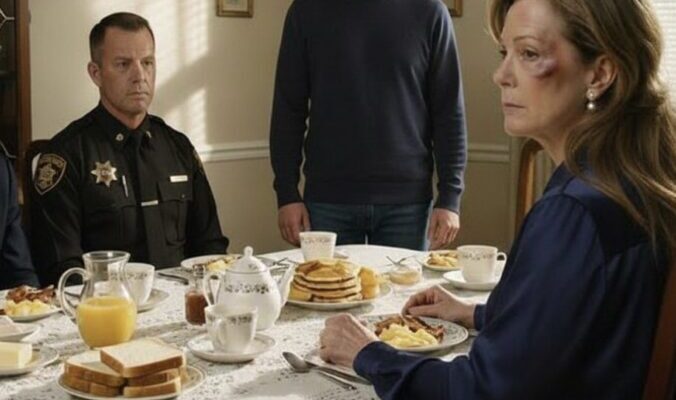
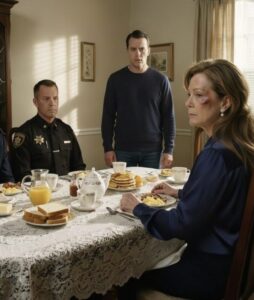
I spread out the lace tablecloth my mother had given me as a wedding gift and prepared a full Southern breakfast—biscuits, sausage gravy, buttered grits, scrambled eggs, and perfectly fried bacon.
I brought out the china we normally use only at Christmas and Easter.
Daniel came down late, hood up, phone in hand. The smell of food made him grin.
“So you finally learned,” he said, pulling out a chair. “I guess that slap finally knocked some sense into you.”
I said nothing. I poured the coffee, calm and composed. He chuckled and reached for a biscuit—then looked up.
The color drained from his face.
At the head of the table sat Sheriff Thomas Reed, his hat placed neatly beside his plate. To his right sat Pastor William Harris from First Baptist Church, hands folded, expression calm.
Next to him sat my sister Elaine, who had flown in from Ohio after a single quiet phone call the night before.
Daniel’s mouth opened, then closed again.
“What… what is this?” he whispered.
“Sit down, Daniel,” Sheriff Reed said evenly. “We need to talk about last night.”
The only sound in the room was the ticking of the clock. Daniel stood frozen, finally realizing that this breakfast was not an apology—but a reckoning.
He hesitated, glancing between the sheriff and the pastor, searching for humor that wasn’t there, before sinking into the chair as if all his strength had left him.
“You called the police on me?” he hissed, trying to regain control. “After everything I’ve done for you?”
I looked him in the eyes. “Do you mean living here rent-free for three years?” I asked quietly. “Or yelling at me when dinner isn’t ready?”
Pastor Harris cleared his throat. “Daniel, your mother showed me the bruise. She told me everything.”
Sheriff Reed slid a folded document across the table. “This is her written statement. Assaulting a family member is taken very seriously in this county.”
Daniel’s confidence crumbled. “Mom, I didn’t mean to,” he said softly. “I was stressed.”
“Your father was too,” Elaine said sharply. “And he never raised a hand to anyone.”
Daniel shoved his chair back. “This is crazy. You’re all turning against me.”
“No,” I said calmly. “This is accountability.”
The sheriff explained the process—options, consequences, and the fact that charges could be filed immediately.
Daniel’s hands trembled. For the first time in years, he looked like a boy who knew he had crossed a line that couldn’t be erased.
“I’m leaving,” he finally said. “I’ll pack.”
“That’s already arranged,” Elaine replied. “Mark is coming with a truck.”
Daniel stared at the untouched plate. “So that’s it? Breakfast and betrayal?”
“This,” I said, meeting his gaze, “is breakfast and boundaries.”
He left without another word. Upstairs, drawers slammed, then silence settled over the house. That’s when I noticed my shoulders no longer felt as tight as they once had.
“You did the right thing,” Sheriff Reed said gently as he stood.
I nodded, my heart heavy but clear. Loving a child does not mean accepting harm. I learned that too late—but not too late.
As they left, Pastor Harris squeezed my hand. “Healing begins today.”
When the door closed, I sat alone at the table, the food growing cold—but for the first time in years, I felt warmth inside me.
Daniel moved out later that afternoon. From the porch, I watched boxes being loaded into the truck, his movements stiff, his pride wounded. He didn’t look back.
That night, the house was quiet—in a peaceful way. I slept through the night, undisturbed. No raised voices. No footsteps echoing through the hallway.
Just peace.
In the weeks that followed, I took the necessary steps. I joined a support group at the local community center. I began seeing a counselor who helped me recognize how fear had quietly replaced love in my own home.
Sheriff Reed checked in once, just to make sure I was okay. Daniel was ordered to attend a court-mandated anger management program. We haven’t spoken since—and for now, that feels right.
Some mornings, I still spread out my lace tablecloth. Not out of habit, but as a reminder—to myself—that I deserve care and respect, even when I am alone.
This is not a story of revenge. It is a story of finally drawing a boundary after years of making myself small. It is about a mother choosing dignity over silence.
And about recognizing that abuse is not always loud or dramatic—often it hides behind excuses, fear, and the hope that someday things will simply get better.
If this sounds familiar, remember: staying does not make you weak, and leaving does not make you cruel. Boundaries are not acts of punishment—they are acts of protection.
To people in the United States who have experienced family conflict, emotional harm, or domestic tension: what helped you take that first step? Did you speak up, ask for help, or set a boundary that changed everything?
Feel free to share your thoughts, your experiences, or even just a simple word of encouragement below. Someone reading it may need it more than you realize.